Your session is going well. After a series of successful barbell back squats you decide to go for a PB with a one rep max. You look around the gym to find someone to ask to spot you for your next set.
The person you choose is vital for you to complete the rep successfully, avoid injury and the possibility of death. I’m not kidding here. A recent death of a bodybuilder with over 200k on his neck tells you that I am being extremely serious. Choose your spotter wisely.
So who do you ask? The obvious choice would be to ask a trainer who works in the gym. But be careful here. You need to know what they specialise in. Have you ever seen them perform a barbell squat or instruct their clients? A trainer with an ego might agree without really knowing what to do. And that goes for other gym members too. They want to help but haven’t got the skill (or strength) to if assistance is needed.
The person with the legs like tree trunks who you see hanging around the squat rack every time you’re in there is a good start. Tell them what you’re wanting to do. It is important that they know your expectations for the lift such as time under tension, reps, your weaknesses etc.
Spotting is indeed a skill. So what are the main points to know if you have a spotter or you are the spotter of a barbell back squat?
1. For a heavy lift, the spotter should place their arms under the lifter’s arms.
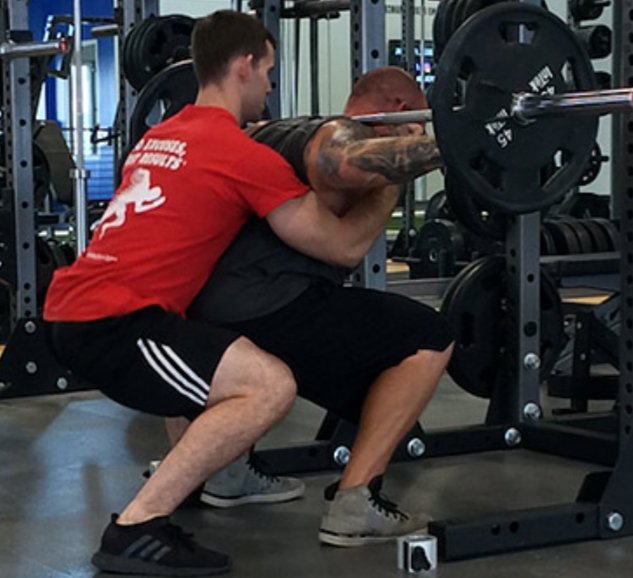
Holding the waist can be fine for moderate weight and can be more comfortable if it is a male spotter and a female lifter. The spotter should not place their hands on the bar. They’re not supporting the bar, they’re supporting the lifter.
2. The spotter should mimic the lifter’s movement on the way down. This is why a good squatter usually makes a good spotter. They must keep a straight back and use their core to get the lifter to the starting position if needed.
3. The spotter should be stood close. There’s no need to look like you’re dirty dancing though, not if the spotter and lifter are using their hips correctly.
4. If it is a very heavy weight, not only can a spotter be crucial in the lift but a person at either side of the bar should be considered. The body can buckle at any point when under pressure and there’s only so much a spotter can do if they’re having to deal with a collapsing person and a weight falling on top of them.
It’s worth pointing out that the body can give way with any amount of weight and this extra weight can still cause serious injury, so extra help at either side of the bar is something that can be considered at any time.
Lifting heavy can be fun and rewarding, but it is essential that you do it correctly. A part of that is finding a good spotter!



 Never Give Up PT