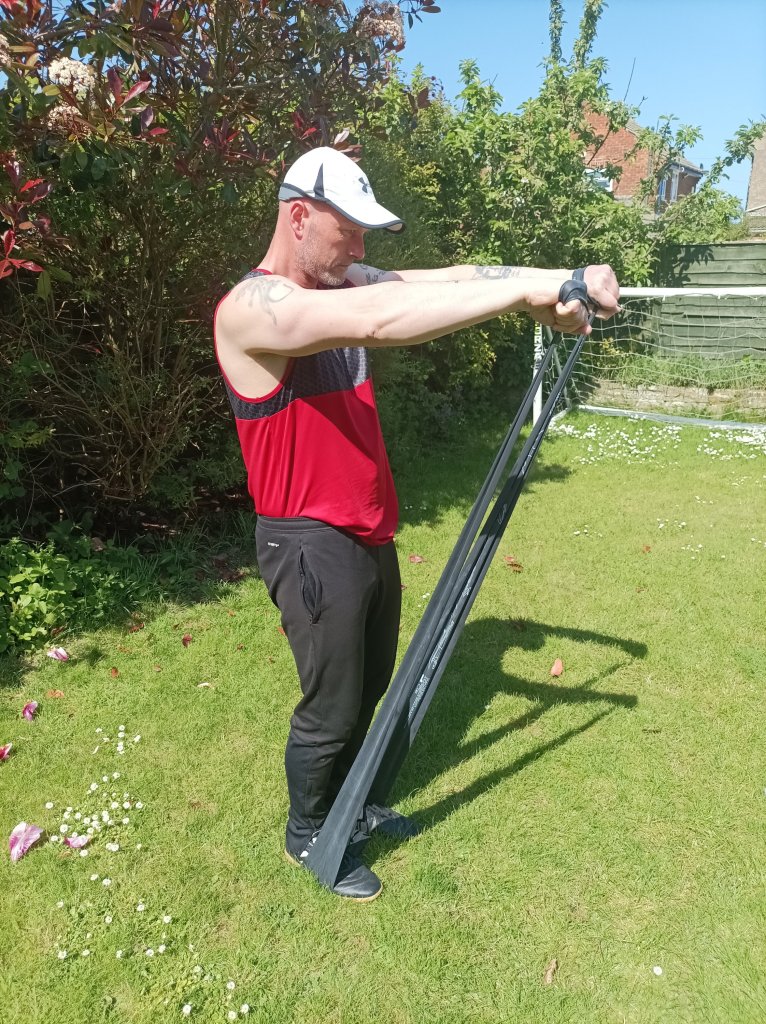
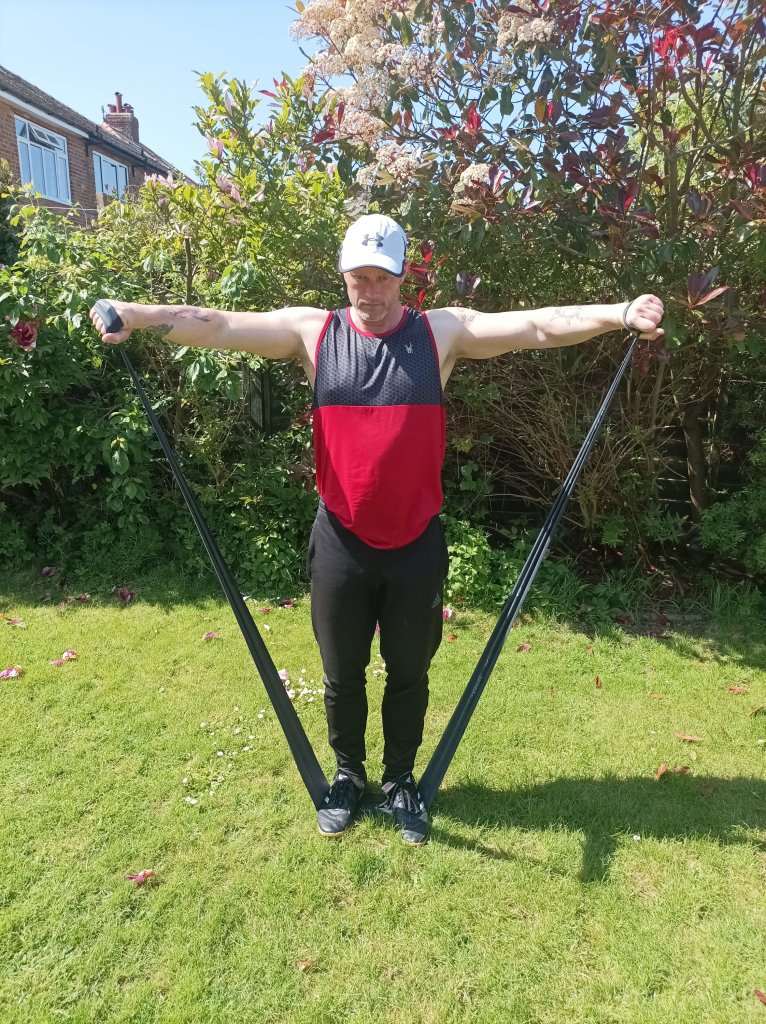
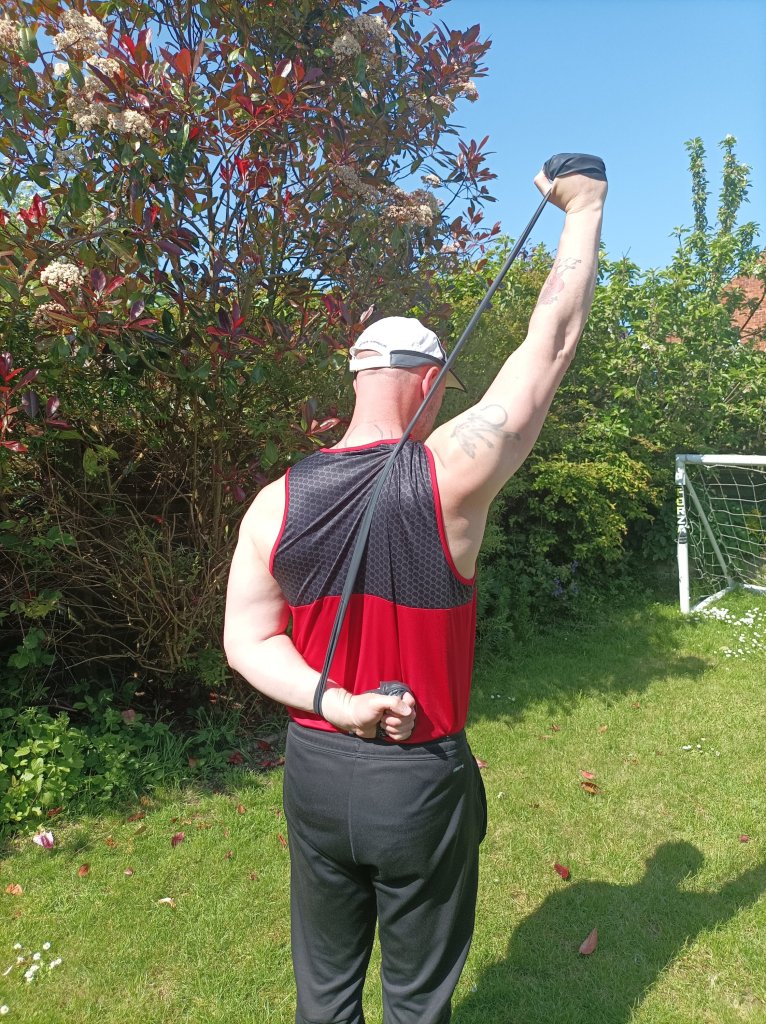
Exercise should be like any other activity…variety is important. If you don’t seek variety now and again, it can become a little stale. And so whatever your goals are, I’m here to give a shout out to using resistance bands as part of your training.
The Benefits
* They are convenient. You could easily do a good exercise routine during an episode of Corrie. This means that you have not had to leave your house to get a workout in. And these days time is precious and you just don’t always have time to get there.
* They are small. Storage is an issue with traditional training equipment, but with these bands they can just fold away back into their case. They make terrible door stops though, so keep a kettlebell nearby for that job.
* They are cheap. Very cheap in fact. Shops like Lidl and TK Max will often stock them for under £5 and the bands will come with a variety of resistance. But be careful, it’s easy to go into these shops for one item and come out with a George Foreman grill, a snorkel and a car cleaning kit as well.
* Variety in your workouts. It’s easy to get bored, especially if exercise isn’t your hobby. Also, your muscles get bored too. Trying out different equipment should be part of the fun for your mind and your body.
* They are good for injury rehabilitation and general aches and pains. After an injury or with sensitive areas it isn’t always a good idea to go straight back to using dumbbells etc. Let your body recover with some simple routines with the resistance bands before hitting the heavy stuff.
So I hope that I’ve managed to convince you that a set of resistance bands can be useful toward your fitness goals.
I’ve just trained at the gym and I’m waiting for my quinoa to cook. I’ll be adding a tin of mackerel and a dash of piri piri sauce to this when I plate it up. Nothing too extravagant, but it does pack a punch in the macro and vitamins department.
And yet, if I’m honest with myself, had I not trained today I would have opted for a couple of cheese bagels with mayo and mustard. Delicious yes, but it hasn’t got the same nutritional value.
I find myself doing this regularly. On training days I will always want the healthier option. And studies show that it isn’t just me. In a recent study at the University of Texas it assembled 2500 people who did not exercise regularly and ate less nutritional foods on a daily basis.
They were put on an exercise program and told to keep a journal including their eating habits. They were asked not to change their diet.
However, within a few weeks it was highlighted that over half of those who kept to their exercise program did change their eating habits. They would often choose fruit, veg, lean meats, fish, nuts to eat on training days.
But what these studies don’t identify is WHY their habits change. So, seeing as I do exactly the same as those in the study in Texas I might be able to shed some light on why.
First of all, I enjoy fried foods. I am currently loving the homemade ice cream that my wife keeps making. I prefer cheap white sliced bread. Cheese would make my top 5 of favourite foods and kebab meat would probably rank pretty high too. I drink beer and wine. I enjoy food. But there’s a physical and psychological process that happens once I train.
Physical
I work hard at the gym. During and after my workout my body feels it and it is my body that demands what fuel is put into it in order to recover. Although the want for fried, less healthy foods don’t go away, the craving for food that compliments my workout and the recovery is very high.
Psychological
I’ve just put an hour of my time into feeling fitter and better about myself. I feel a little lighter and I feel body positive. My need for less nutritional food is not so high that I am going to step out of the gym and go straight into Greggs for pasties and sausage rolls. Today is a good day. I feel good about myself. The endorphins that are released during my workout have triggered a happier, satisfied me. My cheese bagel sounds great, but it’ll be there for another day. For now, I don’t want to feel heavy through stodgy processed food. This food is comforting, but I already have those endorphins racing through my body to comfort me. In other words, I don’t want to feel like I’ve ruined a good workout by eating the wrong food.
When I keep goals very simple such as feeling better about myself, looking fit and healthy for my age and helping myself stay mobile for as long as possible throughout my life then the answer is easy. I can still eat all of the things that make my top 5 of favourite indulgence foods but I am also programmed to give my body what it needs.
Of course, if I were to develop more complex goals then my nutritional needs may become more acute, for example, training for a marathon or a sport at an elite level, a certain weight target or for medical conditions. But I’m not.
The Bottom Line
In an ideal world we would be eating the healthier ‘clean’ foods all of the time, but it isn’t an ideal world. Sometimes you need to grab and go as you work towards a deadline in your course or job. The kids swimming lessons are straight after school and you can only manage a packet of crisps as you scramble them into the car. Or you’ve been invited on a night out and you want a few gin and tonics.
But effort and preparation goes a long way if you keep goals simple. Being more active and giving your body some nutritious food can simply become something that you do. You become programmed to it because it makes you feel good after an activity.
An apple, beans or quinoa might never be in your top 5 of your favourite foods, but they don’t have to be. They just need to exist in your diet to begin with. There’s no such thing as bad food, just bad habits. And I think the key to creating better eating habits lies with us taking some time to exercise regularly.
It’s a strange relationship that I have with the fitness industry. I love it. I truly do. It has enabled me to follow my ambitions and dreams that I thought were beyond me or that had passed me by. I get to meet like-minded people which means I don’t need to bore my wife with news on my new bench press personal best. And the gym is my go to place for getting my head straight. Not many people get to say that about their workplace.
But it is also full of crap. For all the good it can do, there is an element of the industry that feeds off our insecurities.
Dr Gail Hines said,”If tomorrow, women woke up and decided that they really liked their bodies, just think of how many industries would go out of business.”
The fitness industry would be one of them. And in the past couple of decades I believe that the industry has begun to target the other half of the population too. Since the end of the degradation of women in magazines such as FHM and Zoo and newspapers putting a stop to page 3 in the UK, publishers had to target men in a different way. So now they put half naked pictures of male physique models in their magazines and tell them that is what they’re supposed to look like followed by an ad for creatine tablets.
But, despite it being important for the fitness industry to have men across the world feeling inadequate, it is far more lucrative for females to hate their bodies. Or to put it another way, it is more lucrative for the industry to tell women that they should hate their bodies.
For example, we join a weight loss group and go through the torturous weekly weigh ins whilst discussing our ‘syns’. Gym classes are attended mostly by women who are promised that they will burn fat, tone legs bum and tums and blast their abs. Personal Trainers are qualified in form and rep ranges but are way out of their depth when it comes to the emotional side of WHY a person has approached them for help in losing 2 stone in a month. (Some trainers are very good, by the way, but do your homework on them before you give them your money.)
The industry wouldn’t survive if we woke up tomorrow, looked in the mirror and said to ourselves “I am good enough. I am worthy.”
And that doesn’t mean that if we did this we couldn’t still train and eat nutritious food. But we would have a completely different outlook on how we approach our goals. We can always want to achieve a fitness goal that entails lower body weight or bigger muscles, but we would start to do it on our own terms.
The industry wants to confuse us.
When I go to the telly shop for a new telly, I immediately regret the whole process. It’s not that I don’t want a new telly, it’s because I am confronted by a salesperson who begins to fill the air with jargon. Yet, even though this is off putting, I do get excited about stuff that a TV can do that I never thought would float my boat. It draws me in. All of a sudden, things like OLED, QLED, 4k UHD, refresh rates, bezels, quantum dots, low latency and resolutions are the most important things in my life.
Before I know it, I’m leaving the shop with a screen as big as the one at The Odeon and if I can figure out the settings I’m sure it can make me a cuppa tea and give me a foot rub.
Now, I’m not saying that these fancy things aren’t useful on a TV, but I would question if I really needed something so glitzy as the TV that I bought. They are buzzwords. They make us want and need something that we think we don’t already have. It makes us feel inadequate if we leave the shop without a TV to go home to our own TV. Our own TV that might have a wobbly button and it’s a few years old but it still works perfectly fine.
The fitness industry sells us our fitness like a TV shop sells us our TV. They make it sexy and an absolute necessity for our lives. Their jargon and their buzzwords, their special offers and their ‘must have’ product means that we fall for their pitch.
I’ll get a new telly that does what I want it to do in my own time and with the advice of those that I trust. And if we say the same thing about our fitness goals, then we could all sit back and watch the industry do a bit of sweating of its own.
Having spent the past two weeks with kids obsessed with football at a multi sports camp and having two footy mad kids myself, the question “Who is better, Messi Or Ronaldo?” Is asked to me almost daily.
But this question isn’t just something that kids ask. People debating on the terraces, in the workplace, online and in pubs must be one of the most frequently asked questions in the footballing world for over ten years.
So, my answer is usually pretty boring to most people.
The problem with finding the answer here is that we are talking about two of the most gifted footballers to ever play the game. They both have different strengths to each other but they are considered some of the greatest ever because even their weaknesses are pretty strong.
But these footballers are once in a generation freaks who are exceptionally gifted. They are so good that players such as Neymar, Modric, Salah, Mbappe and Haarland simply get overlooked as the best in the world because, even though Messi is in his later years as a footballer, is still winning some of the greatest trophies in world football.
Kids score a goal and instantly celebrate with Ronaldo’s ‘Suuuuiii’ celebration. They are more than great footballers. They are icons. Kids want to be just like them. And when I watch some adults play football in the local park, I suspect they do too.
And whilst this enthusiasm for mimicking heroes is all good fun, I can see an issue with how we view ourselves and how it can affect our own expectations of our own abilities.
I’ll take you back to when I first started going to the gym. I would see the most physically imposing guy in there and want to look like him. He was the gym GOAT (greatest of all time). I would watch how he trained. I would notice the protein shakes he was drinking.
Yet all I was managing to do is raise the bar to a height that might have been way too high for me, my genetics, my lifestyle and crucially my health and physical development.
I didn’t need to be anybody else or aspire to anyone else’s goals. Sure, I can always ask questions and get training tips, but trying to become the same size as Triple H was a poor start to my gym journey. It can be demoralising and, for many people, ends in quitting the gym altogether.
My son Jonas is a terrific footballer for his age. As an under 9’s player he is currently playing in an under 10’s league and looks comfortable. But I do try to keep his feet on the ground. He watches lots of football on YouTube. Rather than watching video after video of Ronaldo and Messi, I would much rather he watched the leadership of Jordan Henderson on TV or even go to the local stadium of Scarborough Athletic and aspire to have the passion of their team captain Michael Coulson.
SMART
When you are wanting to create your fitness goals I would recommend the SMART approach. This stands for Specific, Measurable, Achievable, Relevant, Time. And I’m going to look at the achievable bit for this article.
As I have stated above, I believe that many of us raise our bar to unrealistic levels and if we were to lower it then we would get to where we want to be much easier. It doesn’t mean that we can’t be brilliant at what we do, in fact, if we can look at our achievable goals realistically, then there’s a much greater chance of being brilliant at what we do.
Firstly, you need to recognise your competition. The only competition is YOU. Nobody else. You want to achieve just as much, if not better, than yesterday’s you. This could be by maintaining your physical activities from week to week, looking to achieve an extra mile on the treadmill, putting an extra couple of kilos on the bar, aiming for higher reps or keeping a stable nutritional diet. It doesn’t matter what Hulk is lifting on the platform. It’s your journey, not theirs.
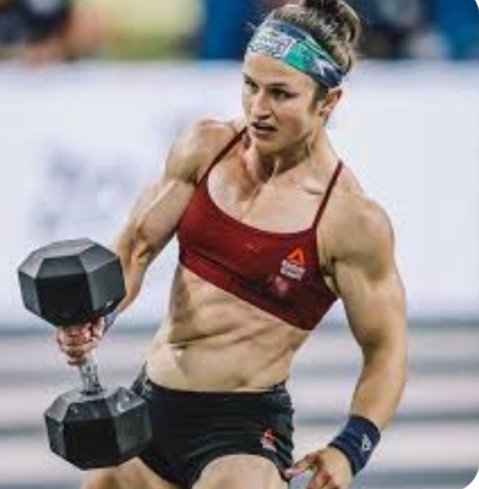
A few years ago I trained a very active 50 year old lady who wanted to gain muscle hypertrophy. As time progressed and her personal bests were increasing she began to show me pictures of Karissa Pearce, who is a CrossFit athlete. My client wanted her physique. I had to attempt to manage my clients expectations. It wasn’t that she didn’t work hard enough in the gym but it didn’t meet the criteria for her achievable goals. Karissa Pearce was a professional athlete in her mid 20’s who was able to train full time and stuck to an incredibly tight diet to get the physique that she had (and still does). My client, despite her levels of enthusiasm and spirit, did not live the same lifestyle and I would not have been doing my job correctly if I enabled unrealistic goals.
The saying goes “Reach for the moon and you’ll land among the stars”. But it can only refer to your moon and your stars. Not Messi or Ronaldo’s, Triple H or Karissa Pearce’s moon or stars. They have their journey, you have yours.
So many young people give up on their dreams because they could not interpret that dream into reality. And adults do it too, until we become a society of people giving up because we couldn’t manage our expectations.
A child should be able to dream about becoming a World Cup winning footballer, but the reality based on statistics in the UK is that a talented kid at football who manages to be invited to an academy has less than 1% chance of making it to becoming a professional at ANY level. However, that shouldn’t burst a kids bubble. If they aren’t one of the lucky ones to make the professional level, then it is worth noting that there are over 5,000 football teams in non-League divisions. This is an excellent standard to reach which is often paid (depending on the league and the club). Just because you don’t have Ronaldo’s career, it doesn’t mean you are rubbish at football.
As a kid I would dream about playing for Liverpool FC and, although I don’t earn the weekly wage of Mo Salah, I did follow my ‘sporty’ dream eventually by becoming a Personal Trainer and I currently coach sports to children. And so we should dream, as long as you manage the reality.
I encourage my own kids to dream about their goals. But, just to give you an example of the sort of stuff they aspire to achieve, it involves mansions, high performance cars, professional football, becoming a YouTuber with millions of followers and traveling to the moon. These are all great ideas, but I also want them to realise that just having a home is winning at life too. Affording any car is a luxury. Having your health and talent to play at any level of football is amazing. Having real friends that appreciate you is special and just being able to see the moon is a blessing.
Reflecting on my own fitness journey, i now understand that my achievable goals are to be able to run and lift as well today as I was doing ten years ago. It’s to fit into the same size jeans as last year. It’s to meet new and interesting people. It’s to keep a positive mindset and feel good about myself. If I continue what I’m doing then I have a good chance in achieving this.
Please, keep dreaming. Aspire in doing whatever you want in life. It really does keep the fire in the belly burning. But when it is time to form your plan of action in your life, be SMART.
This week’s quote of the week comes from the Dutch motivational speaker and author Alexander Den Heijer.
I have read lots of his work based around our environment and how to prime it to suit our needs in which to meet our personal goals.
He encapsulated this message perfectly when he said…
“When a flower doesn’t bloom, you fix the environment in which it grows, not the flower.”
If you now focus on a specific goal that you have struggled with lately, you might find this quote useful to you.
We often put ourselves in the firing line when we don’t meet our own expectations. Perhaps your gym goals have stalled and you feel demoralised by the process. Firstly, the process is something that you must believe in for you to get successful results. So a full overhaul of all of your foundations isn’t what ‘fixing your environment’ means. After all, a flower doesn’t need a tropical rainforest to grow, it might just need a little bit more sunlight at the other side of your desk.
To ensure that you create the proper environment for your gym goals I’ve added a few tips below that should become your positive habit forming actions moving forward. AKA…priming your environment.
* Pack your gym kit the night before. If you’re in two minds on whether you attend the gym today, when your kit is ready to go in the boot of your car then you are far more likely to stick to it than rummaging the drawers for your favourite vest or sports bra during the morning rush.
* Prep your favourite nutritious meals. Batch cook sauces that can be frozen. Defrosting it and making a bowl of pasta or rice is a better alternative than starting from scratch…and if we really can’t be bothered to cook after a long day at work, we resort to takeaways. But you are more likely to stay within your calorie goals by prepping your own meals.
* Be around positive people. Whether it is in the gym or people you hang out with, if you are getting negative vibes from them then ditch them. This might seem like a big decision, after all, this could be a friend you’ve known since childhood or it could be your wife or husband. Talk to them, tell them how you feel, but if you still feel like crap because of what they say and do to you, then move on.
* And on the same theme as above, if it is a job, a gym, a pub or a social group that is holding you back then find an alternative. Find the places that allow you to be you and not what your environment demands of you.
And on that note I’ll finish with a final quote from Alexander.
“You often feel tired not because you’ve done too much, but because you’ve done too little of what sparks a light in you.”
As my son and I walked away from his opportunity to do football training with the older kids the other day I noticed that the anxiety had overcome him. The coach was fantastic, he tried to encourage him to join in. The kids are a good bunch, they would have welcomed my son. But the occasion got too much for him. He just couldn’t do it.
It isn’t the first time. At an open trial event at Leeds United, a similar thing happened. And there’s been lots of scenarios where he has not joined in with something because of this. He gets anxious and I get that. My first ever fitness class in front of 30 experienced class attendees was a disaster because I could hardly get my words out or move my feet. Not a good start for a coach trying to lead the class!
Being good at something and even excelling to become successful at it requires much more than skill and intelligence. My son has this at football in abundance. His ‘football brain’ is excellent for a 9 year old. He has an instinctive mind of knowing what to do in certain situations of a game that is unusual to have at his age. But it’s no use if he can’t walk onto the pitch to showcase this ability. This is a different skill entirely.
Turning anxiety into excitement is an art.
American author Simon Sinek has spoken about the Nerves Vs Excitement situation. During the Olympics he observed that the interviewers would ask the athlete if they were nervous about their upcoming event. Almost in every reply, the athlete said that they felt excited. An elite athlete who has reached the peak of competing at the Olympics won’t get nervous. Despite their talents, had the nerves gotten the better of them then they surely wouldn’t have made the cut to represent their country at the Olympics in the first place.
We could define being nervous as having sweaty palms, a faster heart beat and a future cognitive thought process whereby our minds come up with negative outcomes such as tripping up, losing or getting injured.
And yet excitement could be defined in a very similar way. Sweaty palms, a faster heart beat and, as for the future cognition, this would be our minds coming up with positive outcomes such as winning a gold medal, breaking a personal best and celebrating.
But the interviewers are actually commenting on their emotions. It is them who would feel anxious. They’re not the elite athlete.
And this can be seen in many other, non-sporting contexts. The Great British Bake off contestants will talk of being nervous about baking a cake. Mary Berry would feel excited. She is an expert and the contestants are amateur bakers.
So these elite athletes and Mary Berry have one thing in common and that is the fact that they have practiced their craft a million times before. And during this time there will have been some disastrous events and many soggy bottoms, but they kept on going. Practicing and perfecting their skill until it wasn’t daunting to them in any way, just exciting.
I could only get over my fears as a class fitness instructor by going back to the class each week and training my emotions to get better at it. I knew that I could lead a class, but I had to keep repeating it several times to lose the nerves.
And I know that, had my son trained with the older kids the other day, then he would have been a little bit more prepared for the next week. And the week after. And the week after that. Until a time would come where he felt nothing but excitement to train with them.
One way in which I worked with my initial anxiety about my first few classes was to announce to the participants that I was nervous. I even tried to laugh and make a joke of it. This broke down any barriers that were there between me and the class participants. I became one of them. After all, there are plenty of gym goers who are extremely anxious about stepping into a gym. Them knowing that I was nervous too, seemed to put us all at ease. We could work through it together. I am now about to stand in front of a class full of people whether it be two people or two hundred! The adrenaline would be there, but it would be excitement and not nerves.
We don’t need to be elite athletes to transfer anxiety into excitement, but we do need to keep turning up. Start by thinking about what could go right instead of what could go wrong. Sure, such as life, things won’t always go as you would like, but if you can be at peace with that in mind then the rewards are massive.
Just remember, we can all be guilty of a soggy bottom before we create a masterpiece.
We are all in a constant process of change. How you choose to adapt and evolve is largely down to you as an individual.
Your thoughts and feelings are probably very different to those of 20 years ago. Or 10 years ago. Or one year ago. And even less.
In the time that you click onto this page and read up to this point, your brain has inputted, stored and refreshed this information and it will keep happening every 15 seconds of your life. This continuity field allows the brain to call upon past experiences, snapshots and perceptions and use it in present situations. And because the brain is constantly collecting this information and storing it, we adapt our beliefs, thoughts and feelings along with it.
Once we know and understand this, the quote by Soren Kierkegaard starts to make sense…
“Life can only be understood backwards, but it must be lived forwards.”
The brain is constantly traveling back in time to recall each moment that is relevant for the present experience of the individual. Collecting stored data to form appropriate actions. This is how we are able to scan words when we read.
But, despite these most amazing things happening to our brains, we are the director of change and evolution. This is how habits can be broken and how past experiences can be used for strength, positivity and future happiness.
Heraclitus said…
“No man ever steps in the same river twice, for it’s not the same river and he’s not the same man.”
What did he mean? My interpretation of this is that once you step into a river the water is displaced with new water and the nature of the river is changed permanently. You are also changing.
Just because you have experienced a moment in your life does not mean that you must replay it. It just needs a little rethink, or in the case of your brain, a rewire. We can train our brain to do as we want. We can change what we don’t like, but your brain needs new material to process.
Neuroplasticity is the term used to describe the brain’s ability to adapt to different circumstances throughout your life. Affirmations, which is a technique to instill a positive mindset through repeated words and sentences, is the most popular way of achieving this brain rewire.
Affirmations are often short sentences that can be easily remembered and stored in your brain. And as we have discovered, once your brain has inputted this into its system, it will roll it out when needed.
Governments and ad companies use them too! So it’s not some hocus pocus stuff that some people want to believe.
I’m lovin’ it. Just do it. Get Brexit done. Build a wall. These are just a few examples of successful catchy earworms that are/were repeated to us constantly but there are actually thousands and thousands of other examples of clever affirmations that are instilled into our brain in order for us to act how that particular campaign wants us to act. Well, the good news is that it is actually YOU in control as long as you can counter the influences from around us.
You just need to keep telling yourself and reminding yourself of your aspirations, needs and life goals. If a burger company can make us keep going back to eat burgers with the same texture of cardboard and a government can instruct a whole nation to strip themselves of their rights and leave the EU whilst they titter all the way to their offshore accounts, then I’m sure that we can all manipulate our brains with our own affirmations. Positive affirmations.
When you stand in the river, it changes. Make sure that you change what you want to change too by giving your brain positive things to process. Because when it comes to it, your brain will be using this information to enable you to make those changes.
Continue to remind yourself who and what gets you out of bed each morning. Keep telling yourself how well you could do the new job that you have applied for and repeatedly remind yourself of your health and fitness goals. Write stuff down. Put it on a white board or on the fridge door. Keep your favourite affirmation as a screen saver. Anything at all to allow your brain to compute those words and keep them.
Everything keeps changing. You don’t have to be the one thing that doesn’t.
My two boys love going to their grandparents for an overnight stay. Their granddad, a professional refurbisher of bar billiards tables, often has a finished table in his garage so the boys can take their pool cues that they got for Christmas.
They also get to stay up later on an evening than they would do if they were at home. Staying up later is always a treat! But the biggest treat of all for my 6 and 9 year olds are the meal times at Granny and Granddad’s.
An overnight stay will usually consist of a takeaway or a meal out for burgers or pizzas and a dessert afterwards with a fizzy drink to wash it down with. Basically, lots of foods with very little nutrition.
But I can’t pin this all on their Grandparents, absolutely not! The boys also have occasional takeaway meals or frozen pizzas and chips at home too. The boys have been invited to friends houses for tea, they’ve gone to Macdonald’s for birthday parties, they receive toys for buying ‘Happy Meals,’ supermarket meal deals involve crisps and chocolate, going to the movies encourage us to eat buckets of popcorn lager than my youngest child and reformed chicken comes in the shape of dinosaurs. All of these things appeal to adults too, so we cannot ignore the fact that children will be drawn to such inviting foods.
As parents and grandparents we can’t avoid it, but that doesn’t get us adults off the hook.
I have previously written an article about children being ‘The Great Imitators’. As much as parents believe that their children often do the exact opposite as of what is asked of them, their brains are gathering all of this information that they see and hear and then used as a survival mechanism for when they need it.
How we interact with our partners and colleagues, what we watch on TV, our language, the way we dress and what we eat are all closely observed by the young mind.
As my role as a coach for children during half term, I’m fully aware of how I talk to my fellow coaches. Children listen. Children copy. I’m also very careful about what I eat at lunchtimes with the children. I wouldn’t eat a Greggs steak bake in front of them after having a talk to them about healthy eating. There’s a time and a place. Even for a Greggs steak bake.
So how do we get our children to be more mindful about what they eat? Firstly, it is important to not criticize or ridicule any meal choices that they make. Food should never make anyone feel anxious or ‘bad’. Food should be enjoyed, yes, all food. If a child enjoys chicken dippers then ask them what they enjoy about them. How does it feel and taste to them? Talk to them about what you can add to the plate alongside their dippers.
At home, the boys know that if they ask for fish fingers or chicken dippers it will come with wholemeal wraps, mayo, ketchup and a good sized portion of vegetables. It’s a compromise. For about two years and especially for our youngest who looks like a celebrity doing a bushtucker trial when he’s eating broccoli, the veg wouldn’t be touched without having tears. Now, because we continued putting the vegetables on his plate consistently and he sees his older brother and his parents eat the veg on their plates, he eats his veg without any prompts. He watched and he copied.
We can’t expect our children to choose better options with anything in life unless they see the grown ups doing it too! Sure, their teenage brain along with other teenage peers and influences will challenge their decision making. It is one of the most feared periods for a parent and one I’m yet to experience, but if we can promote the right messages into their young brains now then at least we are giving them a fighting chance as young adults.
My message is clear to the adults that I train and the children that I coach, you can still enjoy all food types and be mindful about what we need to enable our bodies to grow strong, to be healthy and happy, to excel in what they enjoy and to survive. The balance is something that is important to find and it is my job as a parent and coach to help people do that, whether for adults or children. After all, what age group doesn’t like to find the letters of their name with a plate of Alphabites?
I don’t have a device that tells me how many steps I do each day, but if I did, this past week would’ve been off the scale.
During the half term holidays I have been helping out at a sports club for children aged from 5 to 10. The idea is to get the kids as active as possible and to encourage teamwork, movement and healthier eating. And of course if the kids are moving, the coaches are too! One of the coaches did wear a gadget to track his steps and they were over 20,000 by the time the kids had gone home for the day.
During half terms my usual training routine of gym work gets out to one side. This is fine as I schedule these events into my annual training plan. In effect, I know that I don’t need to use the treadmills in the gym for my cardio if I have a productive NEAT (Non Exercise Activity Thermogenesis) regime. And whether it be staying active with my own children or being active with 50 other children, I am comfortable with my activity levels. So I don’t particularly need a device to tell me that.
However, just like tracking my calorie intake, it’s good to check in from time to time and keep myself on my toes! So using such a device is always a credible way of keeping on top of things.
So if we take a look at what 10,000 steps a day can do for your body, hopefully we can all achieve a healthy and balanced lifestyle without slogging it in the gym every day or feeling depressed because we haven’t managed to get to a fitness class this week.
According to research, 10,000 steps a day can strengthen your heart and keep blood pressure under control. It can reduce body fat and maintain a healthy weight (with a sensible eating plan). It can improve stability, muscle tone and strengthen the core. Getting your steps in each day can also improve brain function and help with lowering anxiety and depression.
And we don’t have to panic if we only manage 5,000 steps on some days. We all need to sit and binge watch the new series of You, right?! But it just means that we average out our steps throughout the week. Some days you’ll probably hit the 20,000 mark if you are generally active.
So have a think about how you can achieve more steps into your week. Also, check out a device that will count your steps. It doesn’t have to be expensive, a free app can give you an idea of your activity levels.
And once you find the activities that you enjoy, you’ll find that you don’t even need to be running with 50 kids every day to achieve your steps!
“I like to think that money wouldn’t change me, but when I’m winning at Monopoly I’m a terrible person.” Anon.
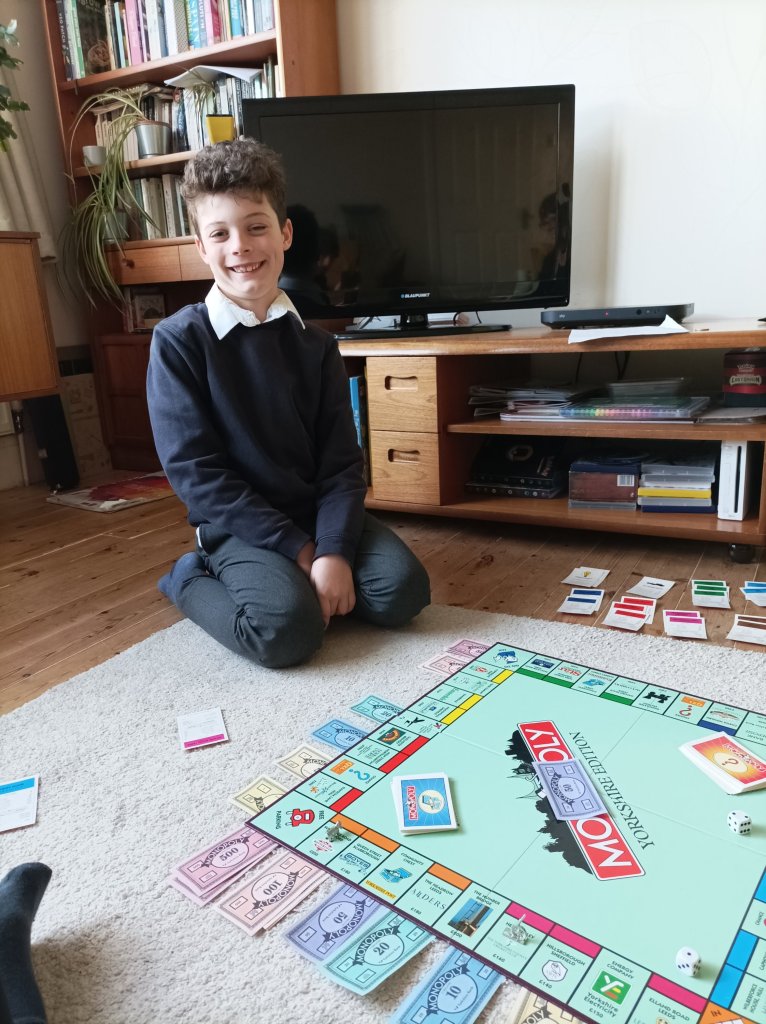
So tonight I beat the family at Monopoly. It’s my second win in a row actually. Last week was the Scarborough edition and tonight was the Yorkshire edition. They stood no chance once I built my hotels around Castle Howard.
I find the game a good learning experience for the kids. They follow rules, take turns, count and subtract, have fun as a family without technology. Hmm. They won too. They just don’t know it yet.
Of course they want to be the one who is the richest by the end of the game. According to the rules that’s how you win, right? But they took part. Isn’t that what counts?
Ok. I’m not comfortable with the ‘It’s the taking part that counts’ angle in this article. You would call bullshit on it and rightly so. We all want to feel that winning feeling sometimes. So I won’t patronise anybody. But I do have another angle and it is from my experiences of coaching adults, and more recently children, in what is actually important when it comes to winning and losing.
Each day I work with children who have one hour in their school time to play in the playground. That is my hour to give them all an opportunity of winning. And I’m not just talking about the one kid who can bat the ball for home runs on each turn.
In a world where some voices are heard more than others, for some of us, just getting a turn is a small victory. It’s a sign that they’ve been heard and seen and where they’ll be given a chance just as much as the kid who stands in front of me, arm aloft, shouting for their turn.
The small wins make big prizes. Just making contact with the ball is a big achievement to some kids. It’s not just the home runs that should make them feel proud of themselves. And so reminding somebody that they have accomplished something that they didn’t manage to do yesterday is a win. Just like making contact with the ball.
And a coach’s attitude can be infectious. Over a period of time, I’ve noticed that the older children or the more gregarious of the group have started to bowl the ball at a slower pace for the batters who are less confident. Now, they are encouraging each other much more. Now, there is a feeling that we are ALL winning at something during the one hour sports session.
And it is no different for adults. We don’t walk into a gym for the first time and leave after an hour looking like Dwayne Johnson or Beth Mead. But with the right sort of encouragement from coaches and other gym members then we can all recognize the small victories. The win is about trying to achieve a little bit more each time you go.
A win can be passing Go or receiving a get out of jail free card. A win can be going without cheese for the day (my personal goal) or completing 50 squats while the kettle boils. A win can be contacting the PT and putting an exercise schedule in place or a win can just be managing to sit on the toilet for 10 minutes without your kids barging in complaining that their brother has kicked them (another goal of mine!)
Winning is easy. Recognizing when it happens can be a bit tougher. But reflecting on your day and looking at the small victories is a good way to start, even if you’ve had to pay out 200 monopoly notes on a stay in Headingley.












 Never Give Up PT