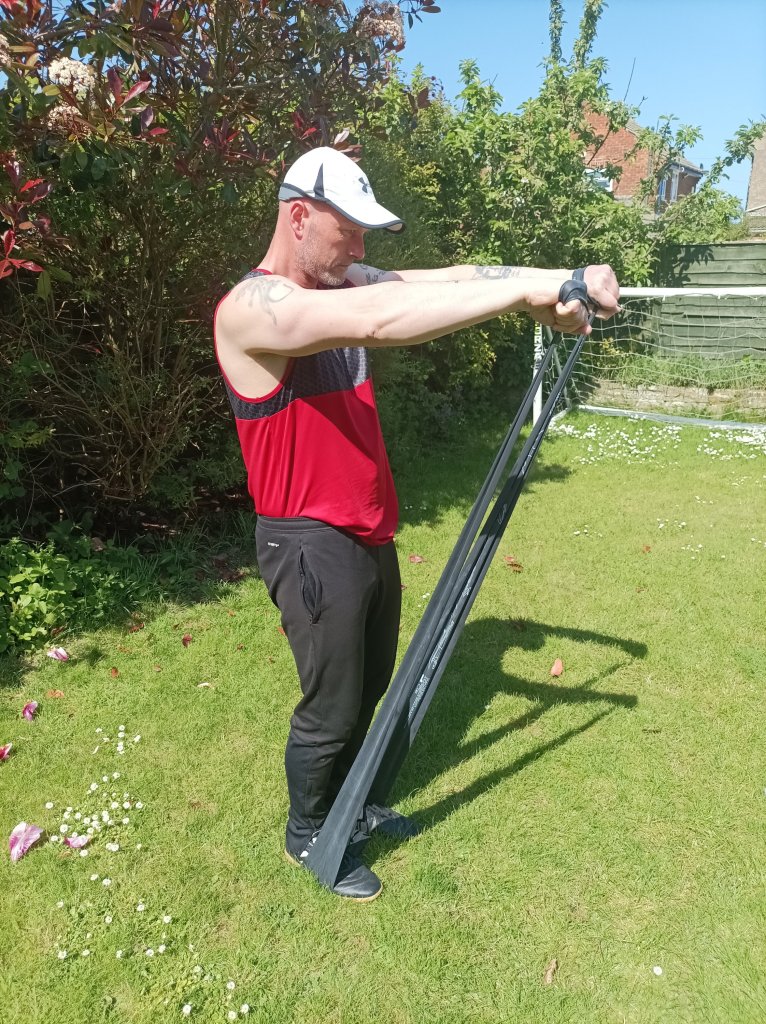
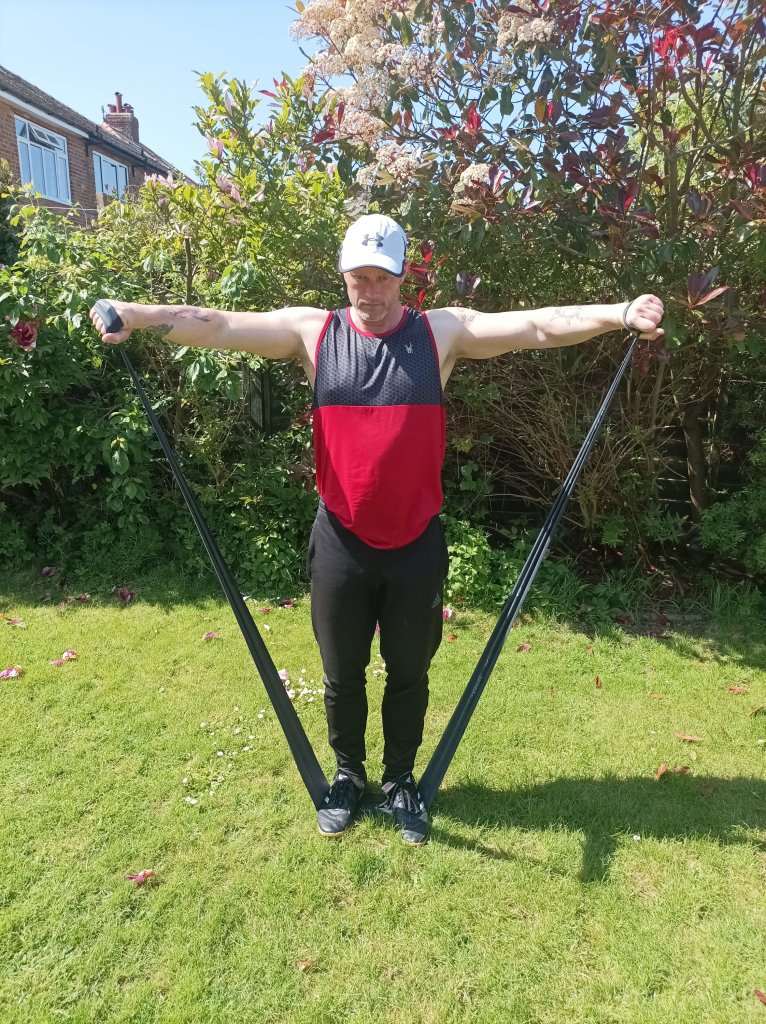
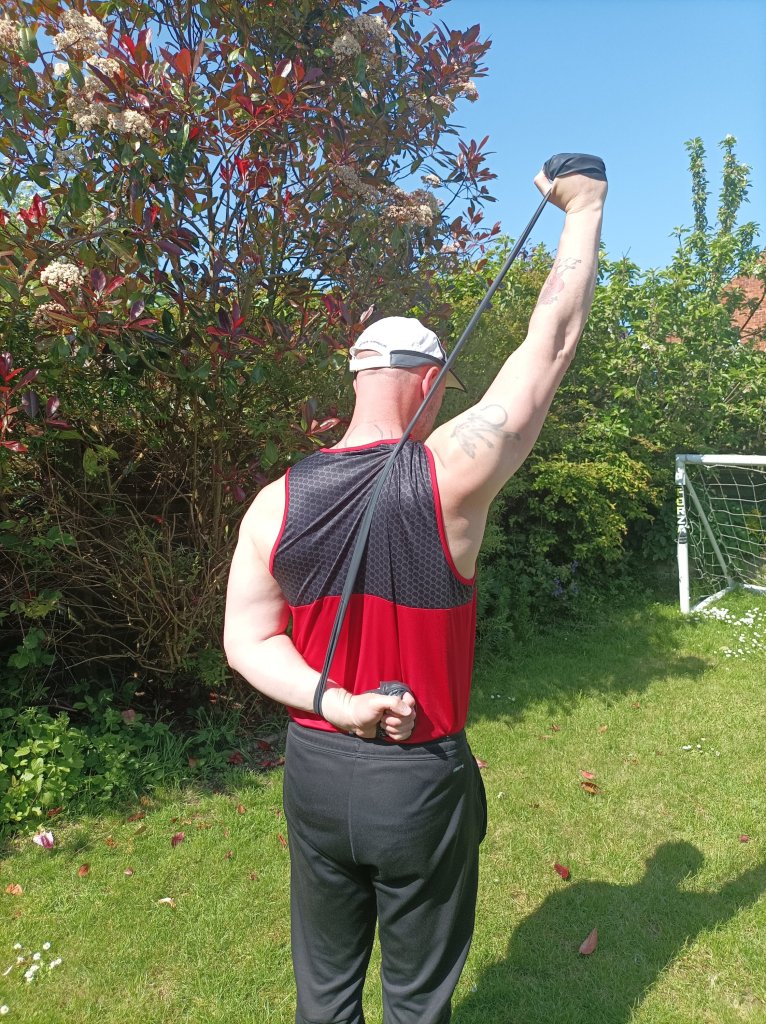
Exercise should be like any other activity…variety is important. If you don’t seek variety now and again, it can become a little stale. And so whatever your goals are, I’m here to give a shout out to using resistance bands as part of your training.
The Benefits
* They are convenient. You could easily do a good exercise routine during an episode of Corrie. This means that you have not had to leave your house to get a workout in. And these days time is precious and you just don’t always have time to get there.
* They are small. Storage is an issue with traditional training equipment, but with these bands they can just fold away back into their case. They make terrible door stops though, so keep a kettlebell nearby for that job.
* They are cheap. Very cheap in fact. Shops like Lidl and TK Max will often stock them for under £5 and the bands will come with a variety of resistance. But be careful, it’s easy to go into these shops for one item and come out with a George Foreman grill, a snorkel and a car cleaning kit as well.
* Variety in your workouts. It’s easy to get bored, especially if exercise isn’t your hobby. Also, your muscles get bored too. Trying out different equipment should be part of the fun for your mind and your body.
* They are good for injury rehabilitation and general aches and pains. After an injury or with sensitive areas it isn’t always a good idea to go straight back to using dumbbells etc. Let your body recover with some simple routines with the resistance bands before hitting the heavy stuff.
So I hope that I’ve managed to convince you that a set of resistance bands can be useful toward your fitness goals.
Queuing for the equipment, sweaty people, pushy PT’s selling their programmes on the back of a beer mat. The gym might not be your cuppa tea.
Loud music or music too low, ogling men, Insta fitters, pricey membership, too far to travel or you just can’t be bothered with going today.
Let me present to you the home workout!
Ok, first of all, let me just say that not all gyms are like the above. Most gyms that I go to these days are friendly, clean and affordable. But still, it doesn’t matter how good the gym is, sometimes you just can’t make it in.
But it doesn’t mean that you can’t train. So I’d like to suggest to you a couple of the most valuable pieces of equipment that you will need in your home to be able to get a good workout in without being in a gym (and it doesn’t cost a lot or take up too much room).
1. A selection of dumbbells. If you find a weight range that covers light dumbbells that you can rep for 15 plus and heavier dumbbells that you can rep for 6 then you will have a whole range of exercises that you can do. But the best bit of kit…..?
2. You. Just you. And I don’t mean you have to ‘turn up to get results blah blah.’ Of course you need to get it done. But your bodyweight is by far the most underrated piece of equipment that is available to you. A good bodyweight workout programme would prove this.
If you weigh 70k then you carry this weight when you walk, squat, lunge, press, jump and run. It is why larger people either carrying excess fat or muscle are able to lose weight faster. The more you weigh, the more energy it takes for your body to move, function and exercise.
Sure, long distance trainers and strength competitors need a whole host of equipment and venues for what they need to achieve, but if you are looking to feel a bit fitter and start the new year with a healthy outlook, you already own your best piece of kit.
We are told that the more experienced we are in our muscle hypertrophy journey, the harder it becomes to create more growth. My own experience can confirm that the science seems annoyingly accurate on this. But it’s not impossible. In fact if you just take a step back and take a look at your own current workouts it’s probably very fixable.
The more advanced we get, the more we tend to add to our workouts. But this takes up more time and before you know it your head is spinning with a myriad of techniques and workouts from YouTube to start stimulating your sluggish muscle growth. And in trying to fit all of this new routine into your sessions you forget about what got you where you currently are in the first place. Sometimes less is more, so let’s get back to basics.
Sure, adding supersets or drop sets to promote stress to the muscle is a good idea, but what you include in your sets (supers or drops) will be an important factor.
I often see traditional compound lifts such as bench press, barbell rows, deadlifts, squats and lunges left behind for more ‘adventurous’ workouts. The problem with this is that the traditional compound exercises are your bread and butter muscle building moves that haven’t been perfected yet.
From close grip bench press, pendlay rows, jump squats, resistance band deadlifts, deficits and animal flow, they can all contribute to your workouts but also you need to stay grounded. Never ditch the traditional lift that the alternative bases itself on.
We can become bogged down with alternative methods and, rather than use them to accompany your routine, they begin to take over. But muscles like consistency. They need to grow into each technique. And perhaps we begin to think that we have outgrown the bench press and the muscle needs a different stimulus, but the muscle still needs to keep learning for it to truly adapt. Chopping and changing a routine just because we see a cool technique from another gym goer or a YouTube guru won’t benefit us unless we stick to our principals.
Regain your passion for a 1 rep max on your bench. Aim to add a little bit more weight over time. Increase the reps. Decrease rest periods. Do what works first and then have a play with alternative methods. Get back to basics.
I’m currently around 6 weeks away from beginning a new program. One which will see me add weight to the bar for shorter reps. Oh, and I’ll be eating in a slight calorie surplus again. Yesssss!
I’ve been keeping the reps high and the weights at around 50% of my 1 rep max since the ending of March which is a good time to be in a slight caloric deficit. This ensures that I look trim in my summer clothes without feeling heavy or bulky.
However, as winter kicks in I want some extra fat to keep me warm and, let’s face it, there’s no need to be going outside in shorts and a T in the UK winter so this is my usual ‘bulk’ season. It’s where I work on my strength and conditioning, put on a bit more size but expect that size to hit my belly too!
But this is still a few weeks away and, to be honest, repping out the low weights has become a little tedious. My body isn’t feeling the challenge and my mind is thinking about my pesto pasta for dinner during lat raises. I sense a plateau.
There are a number of ways to beat a plateau. The worst one is to quit your program and go straight into your next one or, even worse, quitting training altogether! And I have seen plateaus have this effect before. A trainee can become disillusioned by their progress stalling. They become bored. They give up.
Yet switching a program because of a plateau is also a form of giving up. To get the results you want, the process must be followed and completed. This will test your muscle, your mind and your attitude towards your goals. It’s character building. It’s satisfying. It works, as long as you know how.
Enter the mechanical deload.
There are several variations to a mechanical deload, but my current method to beat my plateau is to complete a triset (3 exercises in one set) or a quadraset (4 exercises in one set) which use the same muscle groups for each exercise. Here’s a step by step guide…
1. Choose a muscle group you would like to train.
2. Choose three exercises that use the same muscle group but which have varying levels of difficulty.
3. Choose a moderate weight for each exercise.
4. Begin with the most difficult exercise and rep for 12-15. Then go straight into the easier exercise for 12-15 and finish on the easiest for 12-15.
5. Then reflect on how you thought it would be fairly straightforward but seeing as you’re shaking like a shitting dog and have another 4 sets to go, you know this will break your plateau!
Today I incorporated a chest mechanical deload into a full body workout. Here’s what I did…
Barbell bench press 50% 1rm, 10 reps
Dumbbell bench press 50% 1rm, 10 reps
Smith press 45° bench 50% 1rm, 10 reps
Press up, 10 reps
And because a push workout is great for working the triceps I also added kickbacks, 10 reps, 5 sets in total.
Now, we know that DOMS (delayed onset of muscle soreness) doesn’t necessarily mean muscle gain or a superior workout, but my pecs and triceps are satisfyingly throbbing. Something that I haven’t experienced for around ten days. My plateau, due to experiencing a new kind of stress but remaining within my set task of high reps at moderate weight, seems to have disappeared. I can now utilise this routine for my back, shoulders, legs and arms for the remainder of my program.
A tweak in your program can help you overcome a plateau. Maybe that tweak is a mechanical deload for yourself when you need it.
It is an acronym for the phrase ‘as many rounds as possible.’
Let me explain. AMRAP is a technique which enables the trainee to rep as many times in a set time frame. This could be typically done as a circuit, for example, and there are no rules to what equipment to use, how long or how many exercises.
This technique allows those who find themselves short on time to still manage a quick workout. Even 5 minutes can get the blood pumping and body weight is absolutely fine. In fact, the break for adverts during Coranation Street can see you rack up over 100 reps.
My point here is that I will never accept that you don’t have the time to exercise. Perhaps you didn’t know it or you just couldn’t be bothered and work, kids, cooking meals, feeling tired or clearing out the guinea pig hutch took all of your time up.
But AMRAP has news for you. You DO have time to train. Let’s use my example of Coranation Street as an example…
Coranation Street is an hour long. It has four ad breaks lasting 3 minutes. Imagine completing an AMRAP every break? So your task would be to work continuously for three minutes each time. In just one episode you have 12 intense minutes of exercise.
Coranation Street is on three times a week. That’s 36 minutes of time you didn’t know that you had to exercise. 36 minutes doesn’t seem like a lot but I observe people who are in the gym for one hour but only actually exercise for half of that time. If my estimation of a 100 reps each ad break is accurate, that’s almost a 1000 reps a week.
No amount of time is pointless as long as you do it right. There are many ways to complete an AMRAP. Squats during the kettle boiling, press ups during the Countdown clock or Burpees waiting for a bus. Whatever floats your boat!
There are three things that need explaining when I bring up the conversation of sissy squats. Its name, what they are and why we could benefit from performing them.
As it goes, these points are easily resolved. So here goes…
Why are they called Sissy Squats?!
It actually comes from the name King Sisyphus in Greek Mythology. As a part of his punishment from the Greek Gods he was ordered to push a huge rock up a mountain only for them to push it back down again. He would then have to begin at the bottom again. This forced Sisyphus into a never ending task, but he grew massive quads!
So, I need to push a rock?!
No! The significance here is his quads. And seeing as the sissy squats isolate the quads so efficiently it seemed like a good name to call them. In fact, sissy squats are seen by many trainees as a better alternative to machine leg extensions which can cause knee pain due to the fixed linea movement. Sissy squats are tough, but they can add a little wiggle room if a trainee has had a previous knee injury.
Another benefit is that they work the hip flexors and core strength too. So it’s an exercise not to be overlooked.
How do you perform a sissy squat?
If you have access to a sissy squat machine then you can adjust it as required ensuring that your feet are firmly locked in position. Bend your knees into a squat position and begin to lean slightly backwards. This applies the pressure to the quads but also begins to work the hip flexors and core. Hold for a second or two and then push yourself back to the starting position.
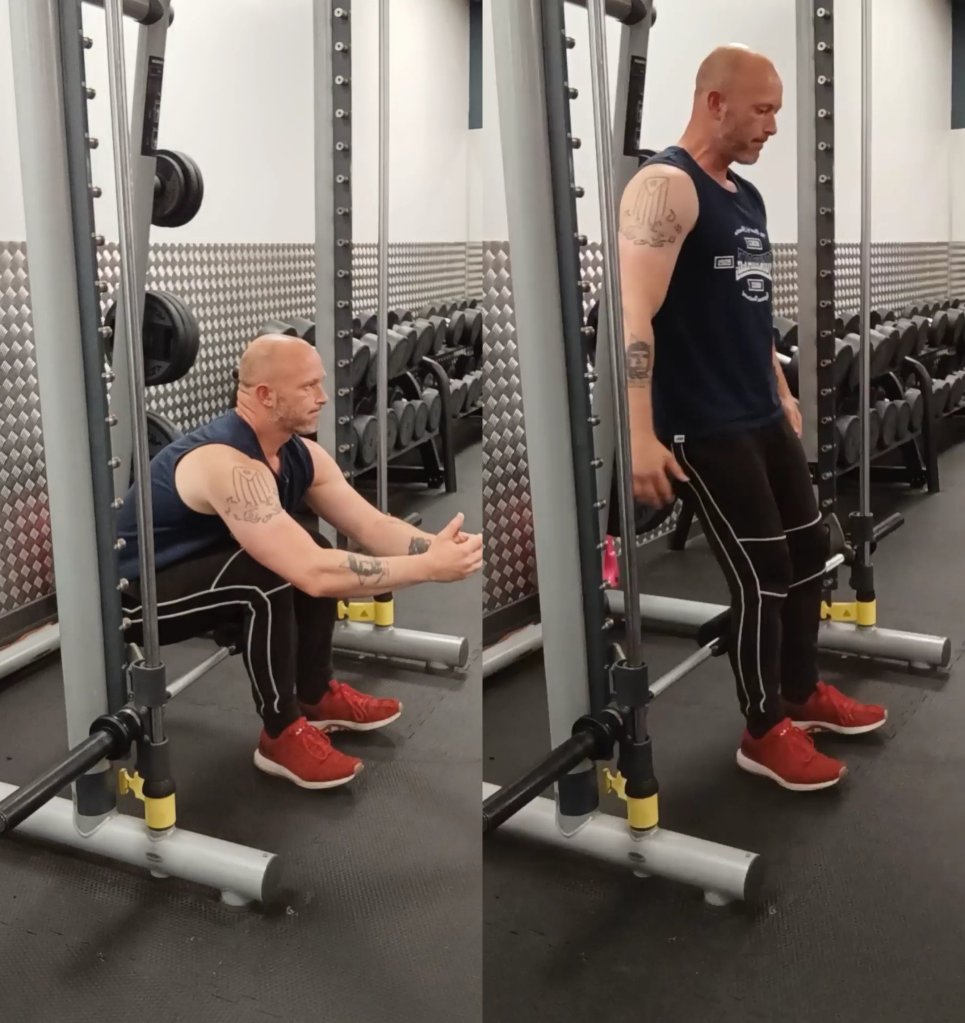
However, there are alternatives if, like my gym, there’s no specific machine. Some leg extension machines can be adapted, but I prefer the Smith machine with the bar at the lowest setting. I place a pad on the bar to protect my calves and I’m able to perform sissy squats.
The small print…
Like all types of squats, if you have a history of knee problems, you need to be careful that you are trained and confident in performing them correctly. As much as squats can be useful in injury rehabilitation, they can also do more damage with poor form.
Attempting any new techniques are often best under the guidance of a professional.



 Never Give Up PT