Why You Should Own A Singing bowl

Before I was introduced to singing bowls or anything at all that represented meditation I was very sceptical about the benefits. Because of this, I feel that I’m in a pretty good place to encourage you in using a singing bowl.

After all, it is easier to convince a skeptic if you’ve been one yourself, right? Well, I think so.

It was no surprise to me that the Personal Trainers who had made body transformations and had made life changing acts themselves were the ones who were the most successful in recruiting new clients in the gym.

They had experienced both sides of the journey. They knew why people were failing in their fitness journey and they knew, going by their own experience, on how to put it right. No matter how good a PT is as a sales person, real life examples where a PT can give background to their story were always a winner.

So, back to the singing bowl. Sort of.

First of all I need to point out that I have always lived as an atheist or perhaps I’ve been also known to be called a humanist. I don’t believe in a god or the afterlife. Certainly not the afterlife that we have been taught by any religion that I know of.

The definition of humanism, according to Humanists UK, describes that ‘in the absence of an afterlife and any discernible purpose to the universe, human beings can act to give their own lives meaning by seeking happiness in this life and helping others to do the same.’

That said, then, how could I possibly entertain the possibility of owning a singing bowl? After all, didn’t they originate from Tibetan monasteries, owned by the monks? It certainly didn’t seem like something I could be enthusiastic about if it had a religious background. If I were to find happiness, I never felt that any religious practice would help my plight.

However, with further research into the singing bowl, I discovered that this isn’t the only reason why it is used. Other than the spiritually fuelled rituals that can be dated back 5,000 years in Mesopotamia, it also has a healing power that can be backed by science.

Ah! Science! Back in my comfort zone. Phew!

Researchers have discovered that, when filled with water, the vibrations of the singing bowl will lift and manipulate the water, causing droplets to dance across the surface in a choreographed way. Researchers found this by filming the process and slowing down the imagery.

Since humans are made up of around 70% water, it begins to make sense that these vibrations made by the bowl can manipulate the human body. The body can begin to harmonize with the bowl presenting opportunities for balance, healing and grounding.
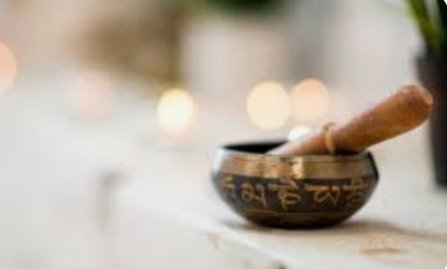
Today’s western use of the singing bowl is often seen in yoga studios, where they can be used in yoga classes but also in sound baths, which is becoming increasingly popular as a form of sound healing along with gongs and chimes whilst meditating.

This isn’t just becoming more popular for adults. As you can see with my youngest child, Finlay, he is perfecting his technique with the singing bowl as he finds it a relaxing experience.

So, have I convinced you to own a singing bowl?

If so, it is important to do your research when purchasing one. Of course, as soon as they know that it is a profitable business, retailers are clambering all over each other to sell you any old tat that has no connection to their origins. They may be a little bit more expensive, but you will love the quality and sound of an authentic bowl hand made in Nepal from a reputable source for instance.
Luvly Jubbly

Those days of running for the bus through Durham City center with a suitcase full of shortbread biscuits still makes me smile.

Lou and I didn’t drive at the time and we were desperate to sell our handmade biscuits at the market a few miles outside of the village we lived in. It reminds me of Del Boy and Rodney running from the old Bill, except what we were selling were pukka!

It wasn’t for the money. Had it been for financial gain then biscuits wouldn’t have been our first thought to make and sell. After the labour and baking costs, the ingredients, the bags and labels, the mark up on a bag of biscuits were pretty crumby, but we wanted to prove that we could sell them. The locals and tourists loved them. We even had VIP treatment at museums such as Beamish as they wanted us to supply them with our little sweet biscuity treats.

The Biscuit Tree was born.

But we also knew that it couldn’t last. We had to make enough money to pay the bills. We had day jobs, sure, but the time that went into making literally hundreds of bags of biscuits each week became difficult to juggle. After a couple of years of standing in all kinds of weather, we hung up our kitchen aprons. We have never been sentimental about a business venture. We moved on.

I’m not a natural salesperson. I sell stuff that sells itself really. It’s not difficult to sell something that has lots of butter and sugar in it. Personal Training is trickier, but I am everything that most gym goers are. Insecure about their body, looking for an endorphin fix and have niggling injuries. I am my own client. Add a bit of knowledge on how to solve these issues and you have a decent PT business.

As a teenager I also sold gym memberships and, although this was doorstep cold calling, they weren’t difficult to sell with the price cuts this particular gym were offering. I also sold mobile phones when just about everyone in the world wanted a Nokia 3310. It wasn’t difficult.

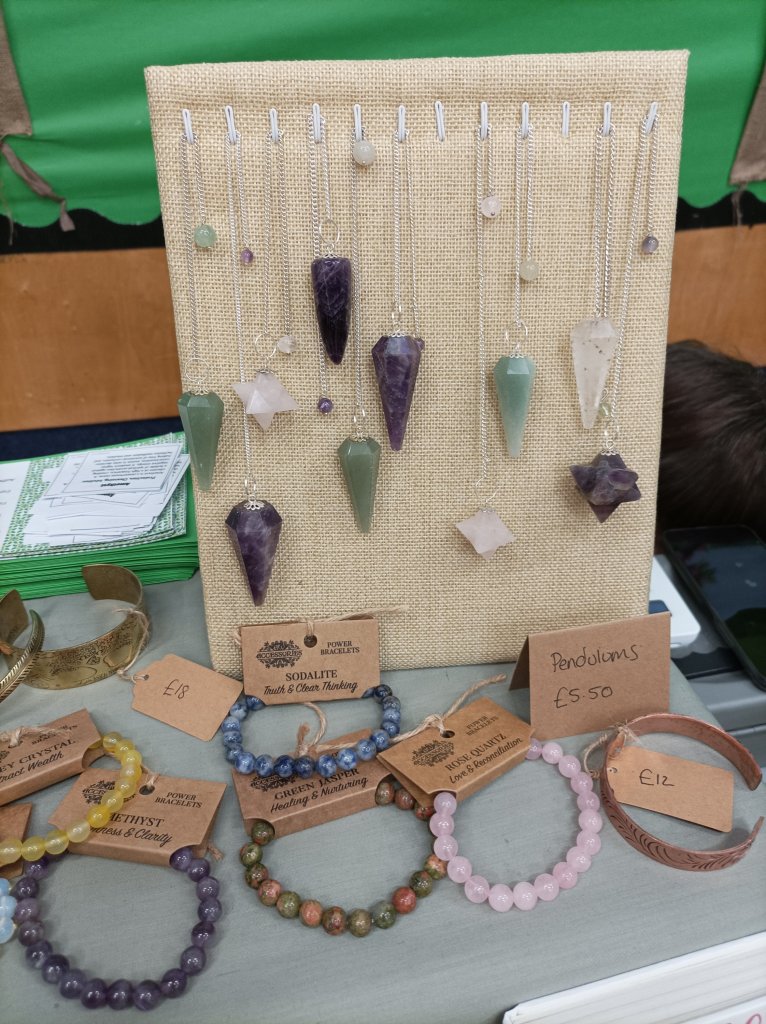
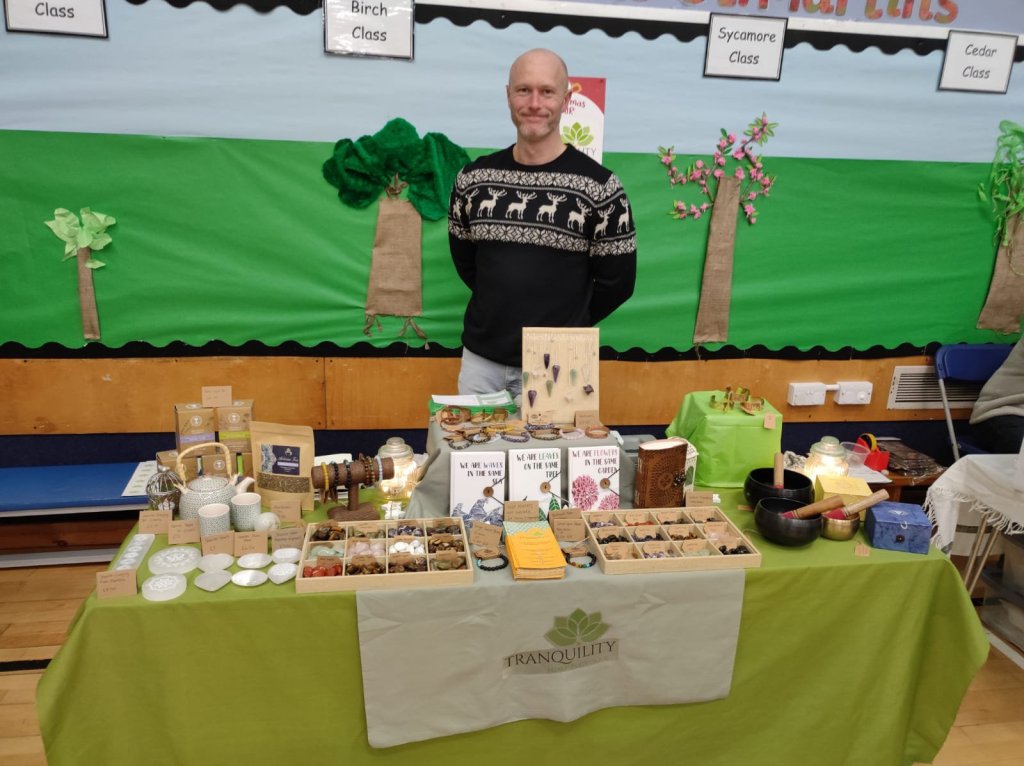
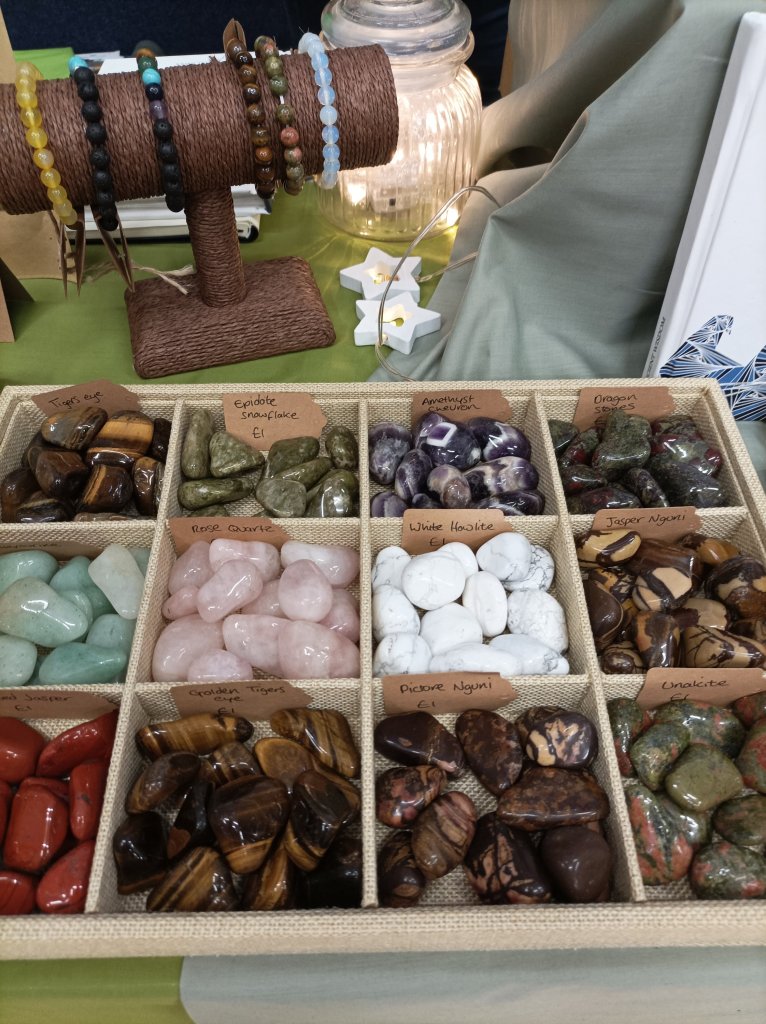
But at our children’s school Christmas fair my biggest challenge was to come. We had a stall selling crystals, gems and healing pendulums and jewelry.

Science can be useful when selling something. I can give tangible evidence as to why going to a gym can be helpful or why mobile phones are useful. But science tends to stutter at healing crystals. However, using my own experience can be something that I can draw upon.

I would never, ever sell anything that I don’t believe in. I want to be able to sleep at night. So when my wife asked me to join her in the stall I had no issues in doing it, but I did need to understand WHY people invest in crystals. Therefore I had to ask myself why I use them, despite a lack of scientific evidence of their powers.

First of all I need to break it down to the basics. We don’t NEED a gym membership to be fitter. We don’t NEED a mobile phone to communicate. We don’t NEED biscuits to be happy. We don’t NEED crystals to heal or give positive vibes. But the latter is the only one that can be traced back to ancient Egypt, India, Rome and Greece and it will continue long after the rest too.

As I stood on the stall last night, a lady approached and looked very interested in the different crystals on display.

“I’m always drawn to crystals,” she said, “but I don’t know what to do with them.”

With no prior experience in selling crystals, I had to go with my gut.

“Pick one up and hold it. Tell me how it makes you feel.” I replied.

She picked up a beautiful rose quartz, known for its qualities in emotional health. She held it tightly and started to smile.

“It feels comforting.” She said.

“Then that’s what you do with a crystal.”

Sold. In fact she bought 5 in total.

During the evening, children and their parents spent a lot of time at our stall and many crystals went to good homes. It was satisfying to do. Much more so than selling phones.

The important thing here is that, even without scientific confirmation, you can still lead with your heart. And it is only recently I realized that. I don’t pray for that exact reason. I don’t know who I am praying to. That doesn’t mean that others can’t pray.

Yet I do feel a power or an aura when I meditate with crystals. It feels right to me. It is empowering.

Just like shortbread biscuits, they can make me feel a bit better.

Random Acts Of Kindness

Even if Dick Dastardly were to be walking up the meat isle in Sainsbury’s and was asked by an elderly person to reach onto the top shelf for a pack of chicken liver for her he would have done it. It wasn’t a huge thing that I did for another person this morning, but I was there to help so I did. It made the lady smile and it made me smile. It gives me a fuzzy warm feeling inside to help someone.

Also this morning, I decided to declutter the side shelf that had managed to breed piles of paper and it was about time that I went through it all. It had been a while. Amongst the papers included was an unopened letter from my opticians from 2021 and a Christmas card sent to the previous owner of our house. I walk past this pile several times a day and just haven’t done anything about it in such a long time. Maybe it’s been so long I’ve just become blind to it. I should’ve gone to Specsavers.

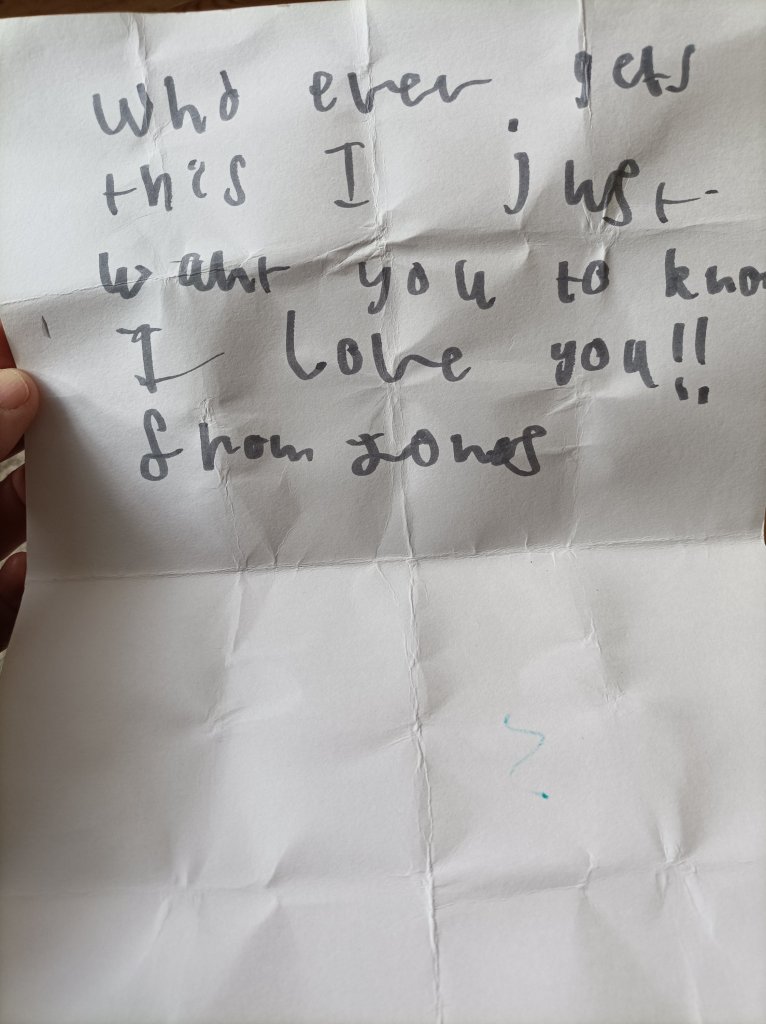
Also nestled in this pile of papers was an A4 sized written message from our eldest son, Jonas. Now, talking of making people smile, he managed to do this for my wife and I with his lovely words of love and kindness. It read…

” Whoever gets this I just want you to know I love you, from Jonas.”

We don’t know when it was written, but it had obviously just got sucked into this pile of papers at some point. But this random act of kindness that can be read by me, his mum or his little brother was a very thoughtful thing to do.

And what a wonderful world we could live in if messages of love, acts of support or a simple smile at random people were commonplace. I do fear, however, that we haven’t got enough of it in our lives.

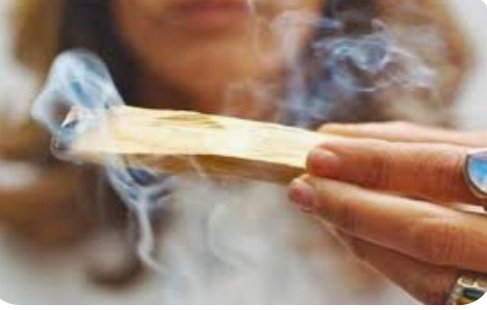
My wife and I have had a rare opportunity to be at home together whilst the kids are at school and sort stuff out such as piles of paper and food shopping. But another practice that we like to undertake from time to time is to cleanse the rooms in the house. We do this by using a singing bowl and palo santo. Burning palo santo wood in your home is called smudging and, with positive intentions provided by your thoughts or affirmations, will cleanse your home of negativity and allow the positive energy to enter.

I’m very much a science based person. I like to see the evidence of something before I can ‘believe’ in it. Yet I seem to be drawn to this 15th century South America tradition. And although I am not religious in any way, I do find many spiritual traditions helpful. Maybe sometimes we don’t need experiments, statistics or numbers to tell us if something works. We just need to feel it. And I do feel the power of palo santo and a singing bowl when it comes to cleansing my surroundings.

I’m trying to be less angry. I’m tired of being annoyed at other pedestrians and road users. I want to be more patient towards people. I’m desperate to hang around supermarket isles just so I can grab another item that had been out of the reach of a shorter person. I want to do random acts of kindness.

But I’m unable to do that if my home isn’t giving me positive vibes. And it isn’t about the annoying pile of papers that need to be sorted out. It’s about finding my home to be a happy place to be. It is where I raise my children, prepare my work and create aspirations with my wife. A home needs positivity.

So maybe we all need to take a look at how the Incas and an 8 year old can create a happier environment in our own homes. Think positively, speak positively, cleanse positively and write positively.

Jonas’ Journey: A Case Study

“Speak to your children as if they are the wisest, kindest most beautiful and magical humans on Earth. For what they believe, they will become.”

Jonas is an 8 year old boy. He lives with his younger brother Finlay, who is 6, and mum and dad. He lives in a house with a garden so he can play football, which he does often, and he has his own bedroom. His mum and dad work and have their own businesses, which can give them a little bit of freedom regarding setting their appointments around spending time as a family. It is considered a safe and loving environment.

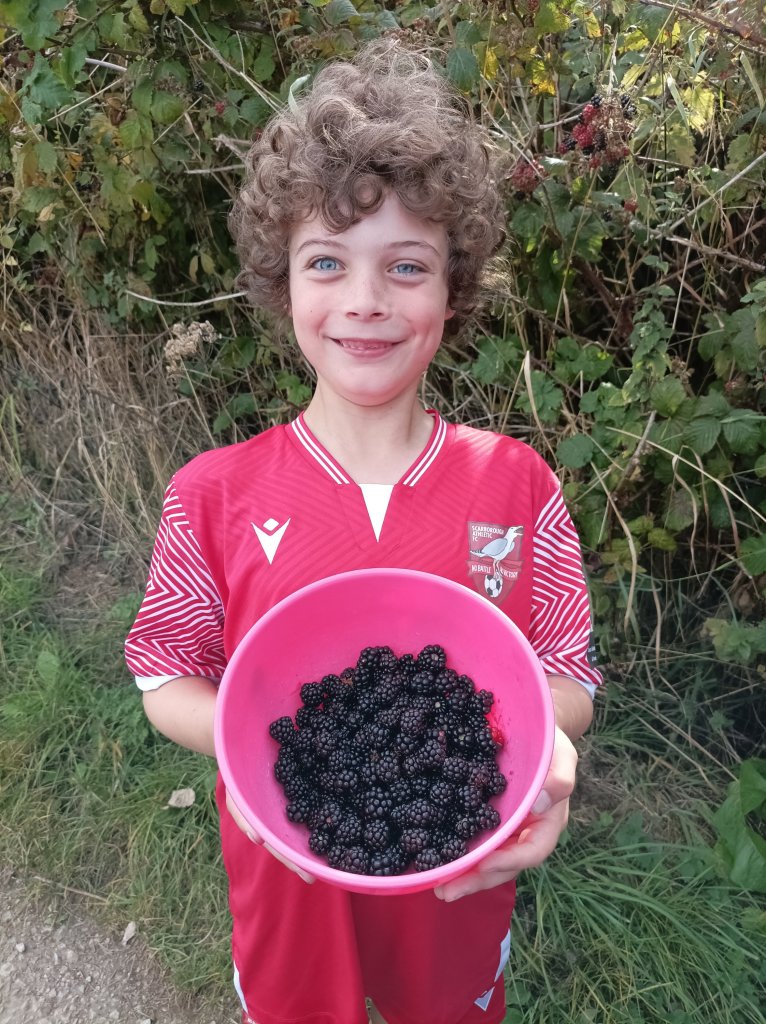
Jonas is a quiet, timid boy. Yet this is perhaps not always recognized by adults that meet him for the first time. His smiley face and big curly hair can give the impression of a confident child. Plus, as a talented footballer, he can play with quite a swagger. It is easy to think of him as a relaxed, calm little boy.

For as long as his parents can remember, Jonas has always shown empathy to others. This can lead him to worry or to become concerned over matters out of his control. Since learning about events in the Bible, he gets very upset for Jesus at Easter time. And he won’t watch Home Alone at Christmas as he gets fearful of the bad men attacking the little boy. This has been a cause for poor nights sleep at times.

And then, just a few months after he turned six, Covid happened. The lockdowns turned this little boy’s world upside down. For the natural worrier, this event was a major setback. His parents too, like so many people, had to find ways to overcome this crisis that had never been encountered before. Unable to work, bills still arriving, concerned for elderly loved ones and with two children unable to see their friends, Jonas’ parents had to dig deep within their resources. They were, however, determined to keep some amount of stability in the most uncertain of times. As a family they would do the Joe Wicks morning workouts, watch BBC Bytesize to help with their children’s schoolwork and go for regular local walks.

But Jonas stopped responding to these daily tasks. He would take himself away for hours at a time to watch TV on his own. He wouldn’t talk about his feelings. A walk was met with a groan and even playing football in the garden rarely happened. His brother, Finlay, also became less motivated but, perhaps because of his younger age, he didn’t understand the magnitude of what he was living through. Jonas did. He overheard many times about ‘death counts’ on the news. Something that his parents would try to hide or mute, but being in the house together for months at a time it wasn’t always easy to keep the news and the daily updates and announcements away from listening ears. And as the laws kept changing in regards to bubbles and the like, his parents had to keep on top of the latest developments.

Eventually, Jonas developed a number of ticks that he couldn’t control. The one with the most impact was a throat clearing tick. He struggled to complete sentences due to his need to clear his throat and his sleep suffered further. This continued when he went back to school and his parents informed his teachers. Jonas’school has been amazing in dealing with the children’s anxieties. His parents are thankful for the school’s ongoing support. Jonas’ ticks still exist, but take on many different forms. His latest one, which is to smell his hand, is less intrusive to him and his classmates.

As has been outlined, Jonas is a very clever and thoughtful boy. He is very aware of his surroundings and the world in which he lives. Since the last lockdown, world events such as the trouble in Afghanistan and the problems in the Ukraine are concerning to him. He has welcomed lots of refugee children and he and his brother also volunteered at a Christian charity to sort out clothes for them. But these unsettling events have led to Jonas believing that any aircraft flying overhead might be going to war or are here to drop bombs. Armed forces day was a particularly tough day for him.

But his parents have always offered reassurance and allow Jonas to express his concerns. His parents are both in the health and wellbeing industry and understand the importance of talking about how we feel. Recently, they introduced meditation to their children. This seems to be a very successful tool for Jonas. Now, almost every night, Jonas requests a meditation guide before going to sleep. His parents have observed that his sleep has never been so good and he can now relax much easier throughout the day.

Jonas remains a little distant from his friends. He didn’t want to do Zoom calls during lockdowns, for example, and perhaps while his friends were still building on their relationships through staying in touch in this way, Jonas might have lost some ground in this area of development. He does seem, however, to be a well liked boy and doesn’t appear to have issues with any other child.

Jonas’ appetite for meditation comes from the empowering nature of the process. During his guided visualizations he has travelled on a cloud, rode on the back of a giant white bird, went to the moon on a space ship and played at the play park with his favourite teddies. Which child wouldn’t want to imagine these lovely thoughts? This process puts them as the central character of this wonderful story that they can develop themselves. They are in control and in a world where some of our children might feel that they have no control, or might feel sad or have worries, empowering them when we can might play a significantly positive part in their mental health, their character development and in their learning as it is for Jonas.

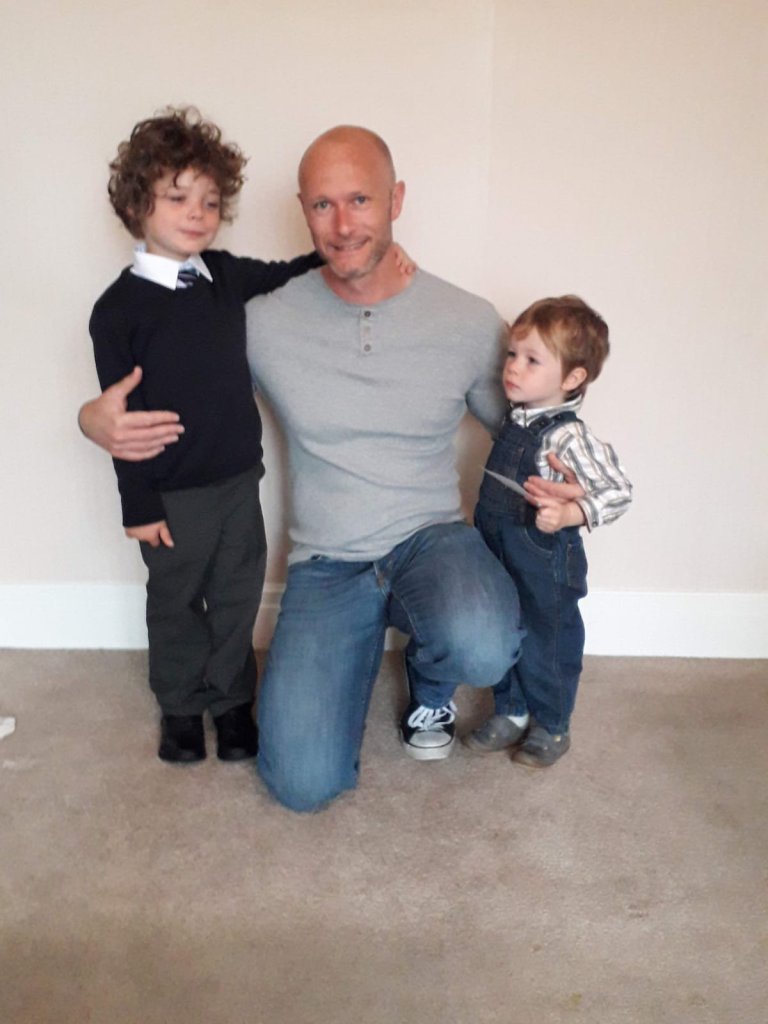
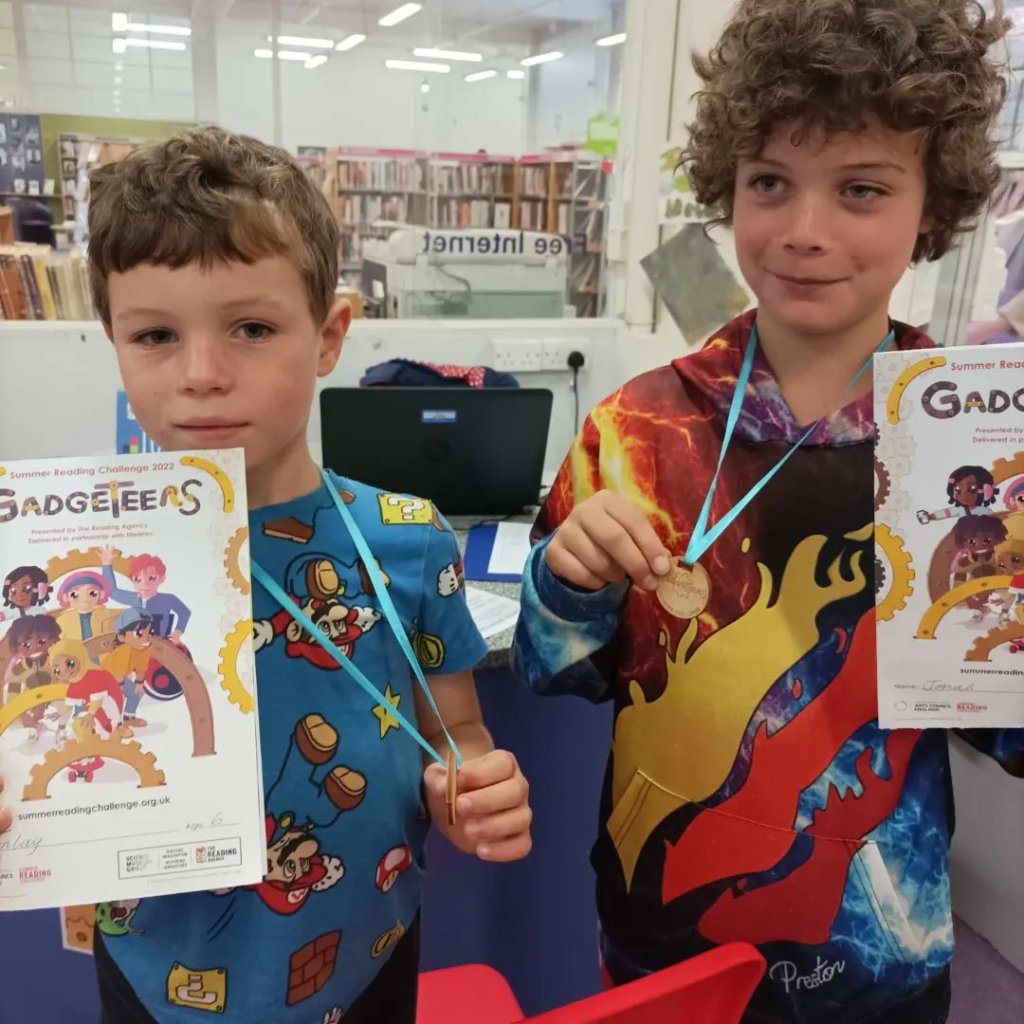
For those of you who are unaware, Jonas is my son. Jonas and Finlay are the most beautiful boys who are two well behaved children. Yes, they bicker, they don’t always tidy up after themselves, they don’t always follow instructions and they do all of the naughty things that you’d expect from 6 and 8 year olds. But they have good hearts and are very kind people.

Now is the time to start recognising our children’s needs. Sometimes we might just need to listen to them. Perhaps they just need a kind word of encouragement. But most of all we must provide a safe place, a sanctuary, in which they are able to open up and allow them to explore their feelings and emotions without them simmering deep inside. As with adults, blocking our emotions can be damaging. Imagine what a child goes through without their maturity to deal with perspective or a clear thought process to channel their feelings.

All of our children deserve to be given every opportunity to be happy. To live without constant fear. To have a safe environment in which to develop and learn. Jonas comes from a safe and stable home, but many children don’t. If we can give them just a small piece of tranquility, shouldn’t we do it?

Alternative Therapies

What do you think about the term ‘alternative therapy’?

So often during conversations about certain therapy that might be useful to a person’s physical or mental health it gets passed off as ‘hippie dippy’ (which is what crystal healing was called by a friend of mine). Other descriptions made to reference alternative therapies are bizaar, ridiculous and weird.

Perhaps some are. We live in an era where multi media can help sell any fad to any group of people or demographics and I have no doubt that many alternative therapies have been hijacked by the billion dollar business of the health and fitness industry. Indeed, if a celebrity brings out a book on maggot debridement therapy alarm bells start ringing to me.

However, many helpful treatments classed as alternative therapies are things that are much older than conventional treatments. Yoga, for example, is traced back to Northern India some 5,000 years ago. Meditation is an ancient practice from 5000 BCE. The Chinese medical text Con-Fu of the Toa-Tse dates back to 1800 BC detailing the application of massage techniques for therapy. Crystal healing, thought to be ‘hippy dippy’ by a friend of mine, was first used 6000 years ago by the ancient Sumerians of Mesopotomia.

Conventional treatment cannot be ignored either, of course. I’m a science man myself. I like the research, experimentation and the practical study of our world. Without it I wouldn’t be able to be a Personal Trainer. I don’t just stumble across a number of movements and hope that they work for a client. I follow the evidence in what WILL work for whatever my client wishes to achieve.

But it is also important to be open minded and question things. And I question everything. I question why our health services are so quick to dispense anti depressants to us. According to the OECD Health Statistics, the USA and the UK have some of the highest numbers when it comes to their citizens taking anti depressants compared to other nations.

The pharmaceuticals industry is worth 1.42 trillion US dollars (statists.com). The antidepressant industry alone is worth 28.6 billion dollars. So I question why our health services would ever want to promote any type of alternative therapy when they earn so much from us popping pills.

And yet I still can’t discredit medicine. It is a fantastic invention that saves lives or can make lives easier to live. Choosing between conventional treatment or alternative therapy is the issue for me. It shouldn’t be a case of either/or.

Personally my last resort has always been turning to conventional medication. In my early 20’s I was prescribed antidepressants. I held the prescription in my hand as I stood outside the pharmacy, wondering if there was an alternative. Down the road to the pharmacy was a gym. I joined that instead.

But the gym didn’t completely cure my anxieties. They’re still there and, as I have discovered, it is just a part of my personality. The gym just helps me to think whilst producing endorphins, which happens to be the body’s very own natural happy drug. There’s me and science again! Any type of movement can produce it. Just do the movement that you enjoy and you’ll get your very own supply of endorphins!

I have never met a person who has not benefited from yoga. And I don’t mean the sort offered by most multi national gyms. You want fixing not breaking. I mean proper yoga taught by a yoga instructor in a yoga studio. I’ve never heard anybody feel worse from a massage treatment performed by my wife. Most people feel that, with consistent treatment, their body and mind feels much more relaxed. And I’ve never encountered a poor meditation. Sitting in silence with your own thoughts and feelings for a short time each day should be a priority to anybody, whatever ailments we have. What’s so weird about that?!

Alternative therapy should always be considered in our quest for peace, happiness, health and fitness. As much as modern day medicine is extremely important, grounding ourselves and opening up our therapeutic experiences in our lives should always be considered.

And if somebody scoffs at you for buying a yoga mat, invite them to do The Crow and enjoy the entertainment.